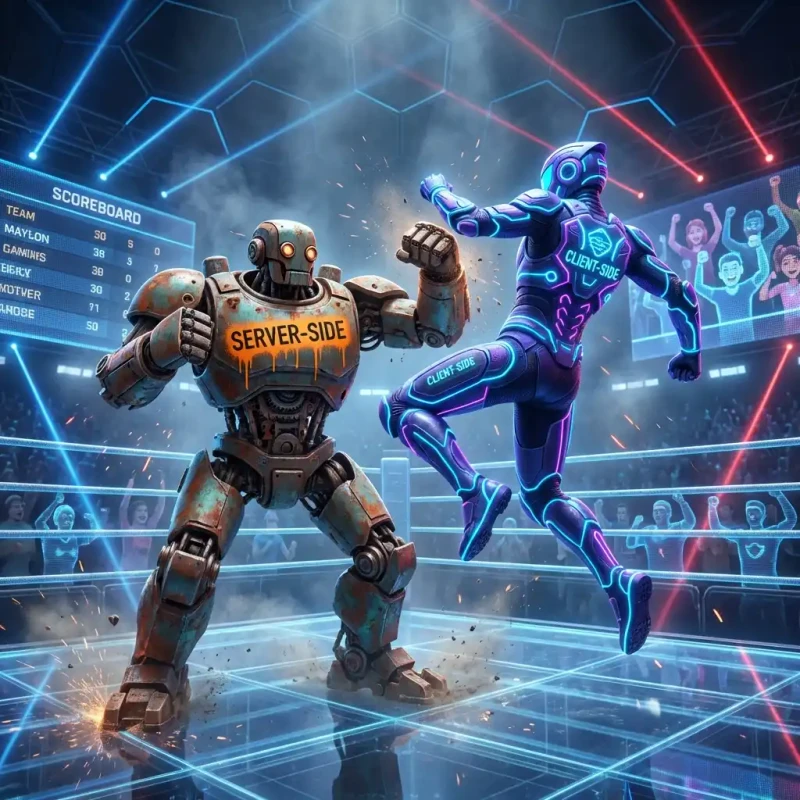
Encryption is good, but 'Zero-Transit' is better. Discover why the safest way to process data is to never send it across the internet in the first place.
In the security world of 2026, two terms dominate the conversation: Zero-Knowledge and Zero-Transit. Both sound great, but they are fundamentally different. While one is a way to hide data from a server, the other is a way to ensure the server never even knows the data exists. At MojoDocs, we chose the latter. We believe 'Zero-Transit' is the only gold standard for absolute privacy.
In this article, we’ll break down the technical differences between these two concepts and explain why, in an age of 'Shadow AI' and massive network surveillance, the safest data is the data that never moves.
What is Zero-Knowledge Encryption?
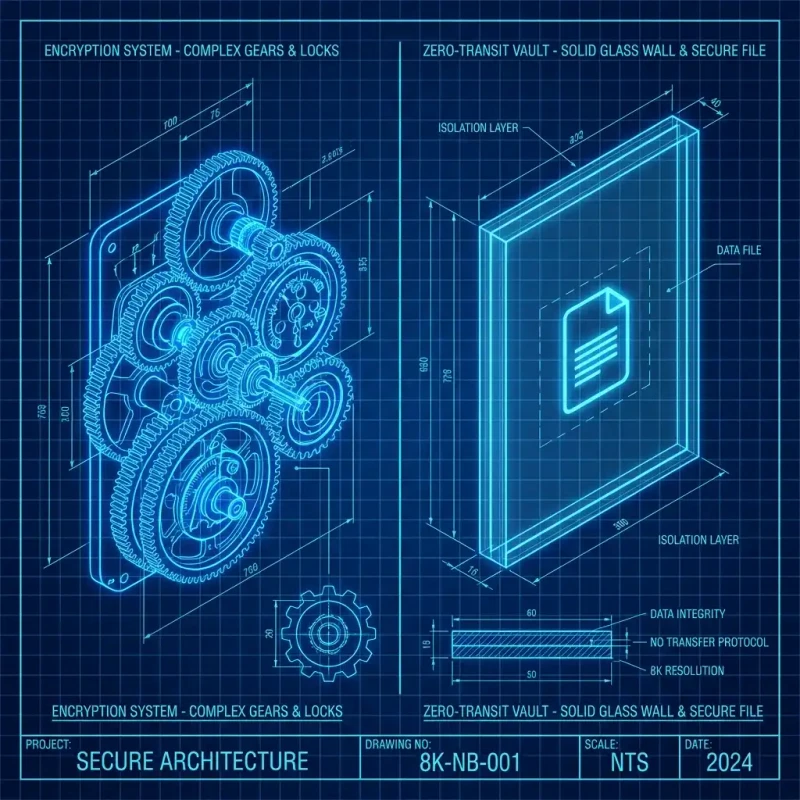
Zero-Knowledge (ZK) is like sending a locked box to a friend. You have the key, and they have the box. They can move the box around, they can store it, but they (theoretically) can't see what's inside.
Popular cloud services use ZK to convince you that your files are safe. But there’s a catch: The box still leaves your house. If the provider’s software has a bug, or if a government forces them to reveal a backdoor in their encryption library, your 'locked box' is suddenly transparent. You are relying on the provider's honesty and their technical perfection.
What is Zero-Transit Processing?
Zero-Transit is different. It’s like doing the work inside your own house. The box never gets shipped. The friend never even knows you have a box.
MojoDocs is a Zero-Transit platform. When you merge a PDF or compress an image, the data travels exactly zero millimeters outside of your browser's local RAM. Our servers only send you the tools (the 'gears'); they don't take your files to 'the workshop.' This is structural privacy. It doesn't require a 'Zero-Knowledge' promise because we have 'Zero-Knowledge' by physical impossibility.
Comparison: The Physics of Privacy
| The Privacy Pillar | Zero-Knowledge (Wait, I'll encrypt it) | Zero-Transit (No, I'll keep it) |
|---|---|---|
| Data Plane | Cloud Host (Remote) | Local Host (On-Device) |
| Encryption Keys | Managed by App / User | Not Needed (No Exposure) |
| Vulnerability | Server Hacks / Key Leaks | Zero (No Network Footprint) |
| Performance | Encryption Overhead + Network | Native Bus Speed |
Why Zero-Transit wins in 2026
In the past, people accepted ZK because local devices weren't powerful enough to do the work. You had to send your 50MB file to a server because your phone would melt trying to process it.
But today, your browser is a high-performance workstation. With WebAssembly, we can perform million-dollar processing tasks in a tab. The technical reason for 'The Cloud' for utility tasks has vanished. Therefore, the security trade-off is no longer justifiable. If you can do it locally with zero risk (Zero-Transit), why would you ever do it remotely with even 1% risk (Zero-Knowledge)?
Conclusion: The Only Safe Data is Local Data
MojoDocs represents the gold standard of 2026 privacy. We don't want to encrypt your data on our end; we want it to never reach our end. By choosing Zero-Transit, you aren't just trusting a promise—you are utilizing a law of digital physics. If it doesn't move, it can't be stolen.
Engineering Insight: Proving Zero-Transit
Power users can prove 'Zero-Transit' by checking the Content-Length on any outbound request from MojoDocs. You will see that while we fetch a few megabytes of code (WASM) to run the app, the byte count of your processed files never appears in any outgoing request. That is the mathematical proof of Zero-Transit.