
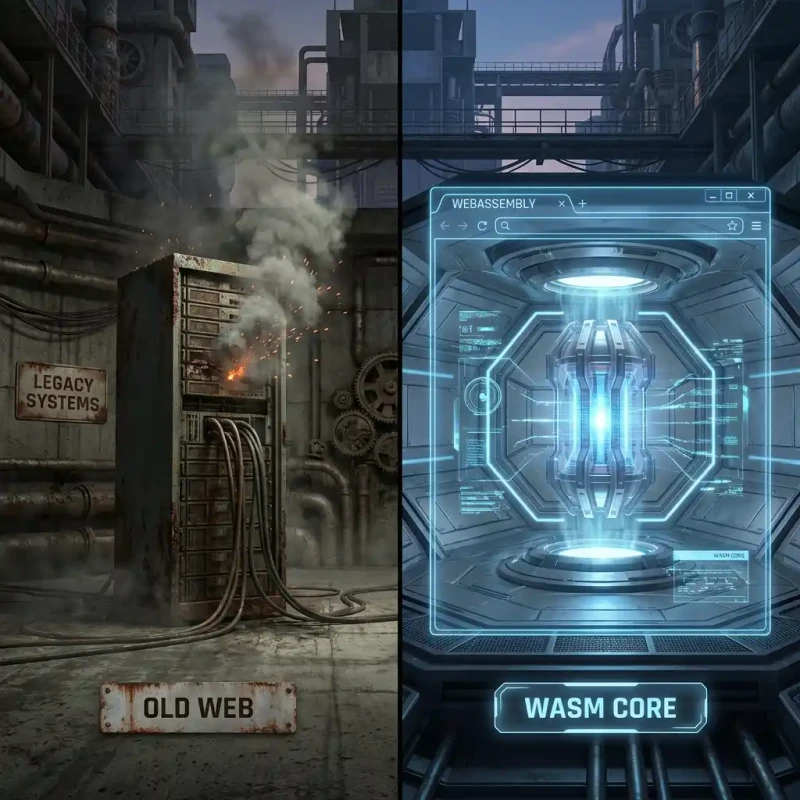
The days of 'Uploading...' are over. Learn how WebAssembly allows your browser to run desktop-grade code, making cloud processing obsolete.
For 20 years, the web had a rule: "The browser is for show; the server is for work." If you wanted to view a cat video, the browser did it. If you wanted to compress a 4K video, you had to upload it to a server farm. The browser was just too weak. But in 2026, a new technology has rewritten the rules of the internet. It's called WebAssembly (WASM), and it has killed the server-side upload.
At MojoDocs, WASM is our engine. It is the core technology that allows us to look like a website but perform like a native app. In this technical deep dive, we'll explain why WASM is the most important privacy innovation since HTTPS.
The History of the "Spinning Wheel"
We all remember the old internet. You found a tool, you clicked "Upload," and then you watched a spinning wheel for 5 minutes. Why?
- Bandwidth Constraints: You were trying to push a 50MB file through a thin copper wire.
- Server Queues: Your file was "Waitlisted" behind 1,000 other users.
- Javascript Limitations: The browser language (JS) was single-threaded and slow at math.
How WASM Works: The "Translator" Analogy
Computers speak binary (0s and 1s). Humans speak languages (English). Developers speak Code (Rust/C++).
The Old Way (Javascript): The browser reads your code line-by-line like a slow reader with a dictionary. It interprets instructions on the fly. This makes it flexible but slow.
The WASM Way: Developers compile their code before sending it to the browser. It arrives as a pre-packaged block of binary instructions—a "WASM Module." The browser doesn't need to read it; it just feeds it directly to the CPU. It's like handing a translator a pre-written speech instead of asking them to interpret live.
The 3 Tiers of Processing Speed
To understand the leap, compare compression speeds for a 100MB file:
1. Cloud Processing (The Tortoise)
Upload (30s) + Queue (10s) + Process (5s) + Download (30s) = 75 Seconds. Plus, you lost your privacy.
2. Javascript Processing (The Hare)
No Upload. Process in Browser (40s). The browser freezes while working. = 40 Seconds.
3. WASM Processing (The Cheetah)
No Upload. Process in Browser (2s). The browser stays smooth. = 2 Seconds.
Why This Is a Privacy Revolution
Speed is nice, but privacy is the real killer app.
Because WASM makes the browser powerful enough to do the job alone, the technical justification for uploading files has vanished.
Companies used to say, "We need to upload your file to our server because your phone is too weak to process it." That was true in 2015. In 2026, your phone has an M4 chip. It is stronger than their server. The "Upload" is now just an excuse to harvest data.
Comparison: Architecture Shift
| Architecture | Legacy Web (Server-Side) | Modern Web (WASM) |
|---|---|---|
| Compute Location | Remote Cloud CPU | Local User CPU |
| Latency | Network Dependent (Slow) | In-Memory (Instant) |
| Security | Data in Transit | Data at Rest |
| Scale | Costs scale with users | Infinite Scalability |
Conclusion: The Future is Compiled
The server-side upload is a relic of a slower web. It belongs in the history books alongside Flash and Internet Explorer 6. WebAssembly has liberated our data from the cloud. At MojoDocs, we are proud to be a WASM-native platform, proving that the web can do anything a desktop can do—without the spy games.
Engineering Insight: SIMD (Single Instruction, Multiple Data)
One of WASM's superpowers is SIMD. It allows the browser to perform the same operation on multiple pieces of data at once. Think of it like a chef chopping 4 carrots with one knife chop, instead of 1 carrot at a time. This is how we achieve real-time image filters and video compression in the browser.