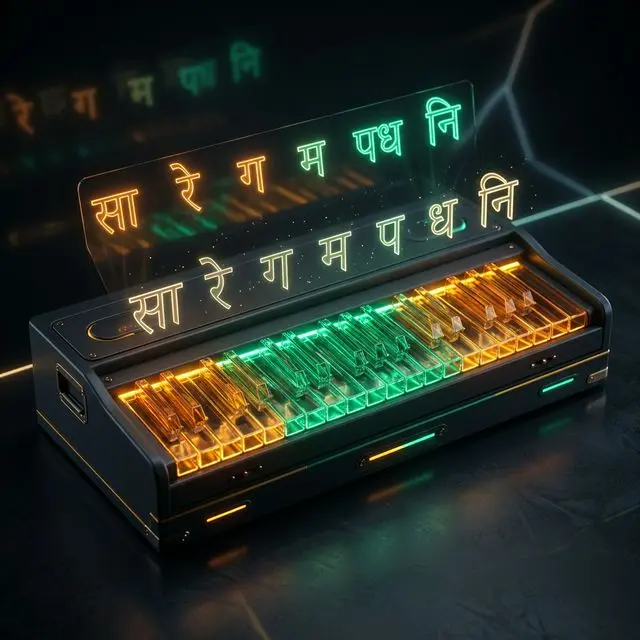

The ultimate showdown: Harmonium or Piano? Discover the engineering differences between harmonic and percussive synthesis, and why the MojoDocs Web Harmonium is the superior choice for Indian Classical music and professional online Riyaz.
If you open a browser tab in 2026 and type "play music online," you are faced with a fundamental choice: do you open a Virtual Piano Online or a Web Harmonium Keyboard? To the untrained ear, they might look similar—both have black and white keys, and both produce sound. But under the hood, they are two completely different engineering architectures.
In this technical comparison, we will analyze the physics of digital resonance, the ergonomics of QWERTY mapping, and the specific use-cases that make the MojoDocs Web Harmonium the superior tool for Indian Classical music compared to a standard virtual piano simulator.
Section 1: Harmonic vs. Percussive (The Physics of Sound)
The primary difference between a piano and a harmonium is how the sound is created. A piano is a percussive instrument. When you hit a key, a hammer strikes a string, creates a sharp 'Attack', and the sound immediately begins to 'Decay' (fade away). You cannot hold a piano note forever; physics eventually wins.
A harmonium is an aerophone (air-driven). As long as you 'pump the bellows' (or hold the web key), the sound remains at a constant volume. It has infinite sustain. In the world of web piano design, recreating this 'eternal breath' requires continuous oscillator output, resulting in a much richer, thicker harmonic texture than a piano.
| Technical Metric | Virtual Piano (Decay) | Web Harmonium (Sustain) |
|---|---|---|
| Note Duration | Fixed (Fades out naturally) | Infinite (Until key release) |
| Harmonic Richness | Clean, Bell-like tones | Complex, Buzzing Reeds |
| Primary Use Case | Western Classical / Pop | Raags / Bhajans / Ghazals |
Section 2: The Mapping Showdown (QWERTY Ergonomics)
When you play a virtual piano keyboard online, the mapping is often non-intuitive. Developers try to fit a 7-octave instrument onto a 10-inch laptop keyboard. This results in "Shift" keys, "Option" keys, and accidental window-closing shortcuts.
At MojoDocs, we optimized the harmonum vs virtual piano experience by focusing on the middle range. By mapping the home row (A, S, D, F, G...) to a standard 3-octave harmonium range, we allow musicians to play complex, lightning-fast taans and alankars with the same speed they use for typing an email. This "Typing-Speed Musicality" is only possible with a mapping system designed for the harmonium's melodic structure.
Section 3: Why Harmonium Wins for Indian Classical Riyaz
Indian Classical Music (Hindustani) is built upon the Drone. To practice singing, you need a stable 'Sa' and 'Pa' that never dies out. If you use a virtual piano, you have to keep re-striking the key every 5 seconds to hear the pitch. This breaks your focus and ruins your breath control.
The MojoDocs Web Harmonium acts as a professional-grade Tanpura and Harmonium combined. Because it is an aerophone-synthesis engine, you can press 'A' and 'G' once, walk across the room, and the notes will stay perfectly in tune forever. This is the ultimate "Riyaz Partner" for serious vocalists.
SEO Strategy: Why "Best Online Harmonium for PC" Matters
Google searches for 'Virtual Piano' are saturated with low-quality flash games. However, users searching for Harmonium for PC are usually serious students and creators. We've optimized the MojoDocs engine to provide 'Exclusive Frequency Range'—ensuring our digital reeds resonate at the exact same frequencies as physical Varanasi-made brass reeds.
Section 4: Micro-Tuning and The 432Hz Debate
A standard piano is strictly "Equal Tempered." You cannot easily 'detune' an individual key on a piano without a professional tuner. However, a harmonium's beauty often comes from its slight imperfections. Our web harmonium allows for Micro-Tuning. You can shift the pitch by single hertz values, allowing you to align with the 'Original Pitch' of an old ghazal recording or a traditional sitar.
Section 5: Conclusion – Which should you choose?
If you are composing a pop song or a Western symphony, the web piano is your tool. But if you are diving into the world of Indian Classical music, if you are practicing your daily Sargams, or if you need an instrument that "breathes" with your voice, there is no substitute for the MojoDocs Web Harmonium. It is the bridge between ancient acoustic tradition and modern browser-based engineering.
Experience the Harmonic Difference
Don't settle for a static piano sound when you can have the living, breathing resonance of a harmonium. Play online for free right now.
Open the Web Harmonium →