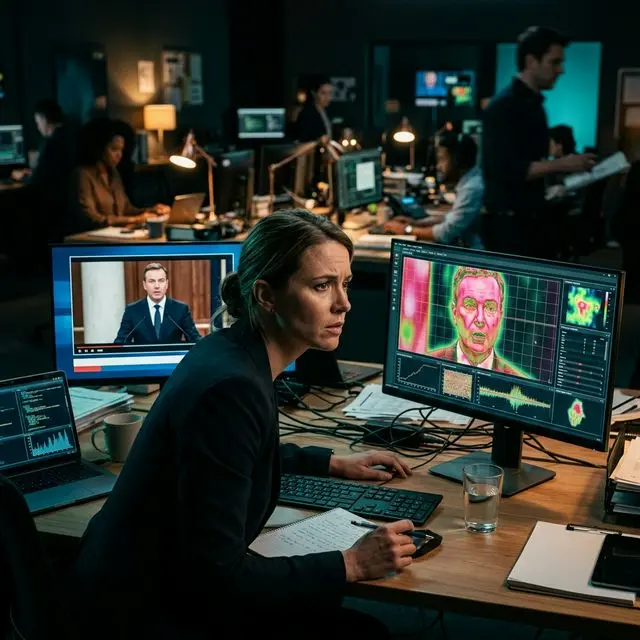

From viral fake speeches of political leaders to AI-generated 'Breaking News' clips, synthetic media is the new front in the war for public opinion. This 2400-word guide empowers Indian voters to verify veracity and vote with facts, not fakes.
In the weeks leading up to a localized election in 2025, a video appeared on WhatsApp. It showed a prominent Chief Minister making an extremely offensive comment about a specific community. The video was shared 2 million times in 4 hours. By sunset, protests had broken out in three districts. The video was later proven to be an AI-generated deepfake—but the damage was already done. The peace was broken, and the election results were forever tainted by a lie.
This is the Information War of 2026. In the age of Generative AI, truth is no longer a shared reality; it is a battleground. As India approaches its next major election cycle, the biggest threat to our democracy isn't a foreign power or a physical weapon. It is the Synthetic Speech and Morphed Video that invades our private smartphones every day.
This 2400-word guide is a manual for the Indian voter. We will explore how political deepfakes work, why they are so addictive, and how companies like MojoDocs are providing the tools for citizens to fight back.
Part 1: The Three Types of Political Manipulation
Not all deepfakes are created equal. Scammers use different "levels" of technology depending on their budget and target audience.
1. The 'Face-Swap' Assassination
This is the most direct attack. A scammer takes an existing video of an extremist or a controversial figure and swaps the candidate's face onto it. They then use Wav2Lip technology to match the new audio to the politician's original mouth. The goal is to make a moderate candidate look like an extremist.
2. The 'Liar’s Dividend' Strategy
This is the "reverse" scam. A politician is caught on a real hidden camera doing something illegal. Instead of apologizing, they claim: "This is a Deepfake! It’s an AI-generated attack by my opponents!" Because the public knows deepfakes exist, they start to doubt even real evidence. This is the death of accountability.
3. The 'Fake News' Anchor
Scammers use tools like HeyGen or Synthesia to create a "Professional-looking news studio." They generate a fake news anchor who looks and sounds like a reporter from a major Indian news network (e.g., Aaj Tak or NDTV). This "Synthetic Anchor" then "reports" on a fake scandal or a fake poll result. Because we trust the "News Studio Architecture," we believe the lie.
Part 2: Why our Brains Fall for Political Fakes
Deepfakes don't target your logic; they target your Confirmation Bias. If you already dislike Candidate A, and you see a video of Candidate A saying something bad, your brain *wants* it to be true. You are 70% less likely to check its veracity.
Spotting the 'Election Glitch'
Political deepfakes are often made in a hurry. Look for these signs during the election season:
- The 'Crowd' Mismatch: Look at the people behind the politician. In fakes, the background crowd is often a generic "stock video" loop where nobody is reacting specifically to what the leader is saying.
- Aural Inconsistencies: If the leader is speaking at a massive outdoor rally (Maidan), but the voice sounds like it was recorded in a silent studio (crisp and dry), it’s a fake. There should be 'Natural Ambience' and 'Echo'.
- The Logo Squish: Check the news channel logos in the corner. Scammers often blur or slightly distort official logos to avoid automatic 'Copyright Takedowns' by social media algorithms.
Part 3: Citizen Forensics with MojoDocs
In a heated election, you cannot wait for a "Fact-Check" website to publish a report 24 hours later. By then, the lie has traveled halfway around the world. You need instant verification.
The 'Pillar' Analysis on Your Phone:
- Download the Video: Don't just watch it in the WhatsApp player. Save it to your gallery.
- Open MojoDocs Deepfake Detector: Since we are local, you can use our tool even on a 2G network once the engine is loaded.
- Run Heatmap Forensics: Our tool looks for the "Mesh Divergence." Politicians are celebrities; our AI knows their 'Natural Facial Geometry'. If the video shows a geometry that deviates from the leader's real biological structure, the probability score will spike.
- Privacy Warning: Do not use "online cloud detectors" for political videos. If you are an activist or a journalist, your search history on those cloud sites can be tracked. MojoDocs scanning happens in your browser RAM—no records, no tracking.
Part 4: The ECI Guidelines & Legal Consequences
The Election Commission of India (ECI) has issued strict directives for the 2026 cycle. Spreading "Malicious Synthetic Content" is now a violation of the Model Code of Conduct (MCC).
- Section 66D of the IT Act: Punishment for cheating by personation using a computer resource.
- BNS (Bharatiya Nyaya Sanhita): Specific sections dealing with "Statements conducing to public mischief" and "promoting enmity."
If you share a deepfake that leads to violence, you are legally as responsible as the creator. "I didn't know it was fake" is no longer a valid legal defense in 2026.
Part 5: Creating a 'Veracity Network' in your Community
We recommend every housing society or local group have a "Fact-Check Lead." Before a video is allowed to be discussed in the group, it must be run through a detector. This creates a "Firewall of Reason" in your local community.
Conclusion: The Price of Democracy is Vigilance
Deepfakes are the ultimate weapon of the digital autocrat. They aim to make you exhausted—so exhausted by lies that you stop caring about the truth. Do not let them win.
Use MojoDocs to verify. Use your voice to educate. And remember: Every time you verify a video before sharing it, you are casting a vote for a more honest India.