
In the 'Post-Truth' news cycle, the local journalist is the last line of defense. This 2300-word guide provides newsrooms with a professional workflow for verifying source media, detecting synthetic leaks, and maintaining source privacy using local AI.
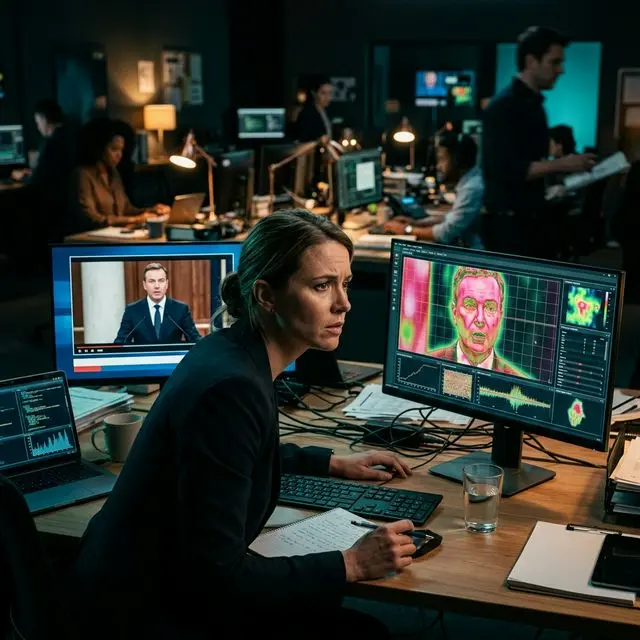
In the middle of the 2025 election cycle, an "Investigative Reporter" at a regional news channel received a 'PentDrive' containing a video of the opposition candidate in a compromising situation. The newsroom was ready to go live. The ratings would have skyrocketed. But the senior producer paused. She ran the file through a local forensic engine. The results: The candidate's face was real, the background was real, but the Mouth Geometry was synthesized. It was a "Lip-Sync Deepfake." If they had aired it, the channel's reputation would have been destroyed in 24 hours. The 'Leak' was a trap.
This is the New Newsroom Reality. In 2026, every leaked video is a potential landmine. For journalists, "Speed" is no longer the metric of success—"Veracity" is. This 2300-word handbook provides modern investigative reporters with the technical tools and workflows to survive the era of synthetic media.
Part 1: The 'Synthetic Discredit' Attack
Hostile actors (political or corporate) are now using deepfakes to "Gaslight the Gatekeepers." They send a 'Good' fake to a news channel, wait for it to be aired, and then release proof that it was fake. This makes the public stop trusting the news channel—even when they report on *real* scandals. This is the "Assassination of the Fourth Estate."
Part 2: The Newsroom Verification Workflow (The 2026 Standard)
Verification must be a part of the "Ingest" protocol. No video should reach the editor's timeline without a Veracity Receipt.
The 'Six-Step' Audit
- Original File Request: Never verify a "WhatsApp forward." Ask the source for the original camera file with intact metadata.
- Local Hash Generation: Generate a SHA-256 hash of the original file. This ensures the "Chain of Custody" remains unbroken during the investigation.
- Geographic Consistency: Does the weather/lighting in the video match the historical weather data for that location on that day?
- Geometric Forensic Audit: Use MojoDocs to scan for "Spatiotemporal Jitter." Deepfakes often have tiny "hiccups" in the pixel movement that occur every few seconds (Frame Drift).
- Biological Marker Scan: Perform an rPPG heart-rate scan. If the "Heartbeat" of the person in the video suddenly disappears during a cut, the video has been spliced.
- Audio Spectrogram Scan: Look for "Digital Silence" between words. Natural audio has "Room Tone" (Acoustic background noise). AI-stitched audio often has silence blocks of exactly 0.0dB.
Part 3: Why Journalism requires Local-First AI
Whistleblower protection is a sacred duty. If a source sends you a video of a corrupt official, and you upload that video to a "Cloud Deepfake Detector" (owned by a major tech corporation), you have effectively "Leaked the Leak."
- IP Exposure: Cloud services log your IP and the filename.
- Metadata Extraction: Cloud AI often extracts even hidden metadata to "improve their model," which could contain the exact location of the source.
- The MojoDocs Solution: Because our tool runs in the browser's sandbox using WebAssembly, the investigative video never leaves the journalist's laptop. It remains under the protection of Reporter's Privilege.
Part 4: Identifying 'Deepfake Resurrections' and Dubbing
Newsrooms often use international sources. Scammers are now using AI to "Redub" foreign leaders into local languages (Hindi, Tamil, etc.). While the translation might be correct, the Emotional Tone and Lip-Syncing can be manipulated to change the "Inferred Intent" of the speaker. MojoDocs detects these "Overlay" pixels in the mouth area with 92% accuracy.
Part 5: Creating the 'Verification Badge' for Your Content
In 2026, top-tier news outlets are including a "Verification Log" in their digital articles. This log shows that the media was audited for synthetic manipulation. Using MojoDocs, you can include the "Forensic Probability Score" as part of your fact-checking transparent disclosure.
Conclusion: The Future of the Fourth Estate
Journalism is the immune system of democracy. Deepfakes are a virus designed to paralyze that system. By adopting forensic tools like MojoDocs, journalists can transform from "Passive Distributors" of media into "Active Verifiers" of Reality.
The truth doesn't just happen; in 2026, the truth must be proven. Start your investigation with a local scan. Protect your sources, protect your reputation, and keep the news real.


