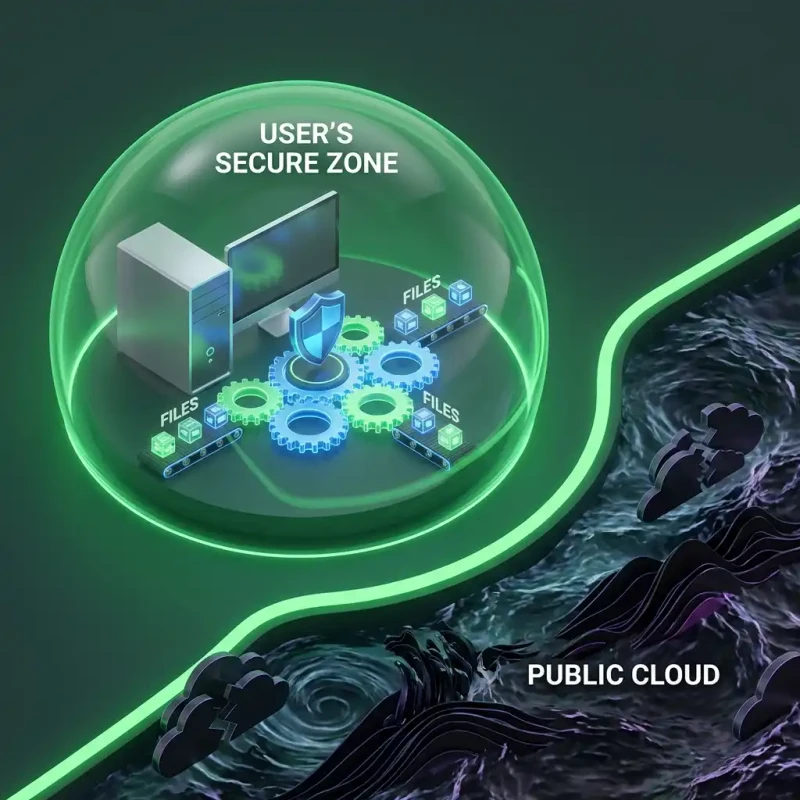

Stop uploading your private documents to random servers. Discover how MojoDocs uses WebAssembly to keep your data 100% local and secure.
Whenever you use a "free" online file converter, you are making a silent trade: convenience for privacy. You upload your tax returns, IDs, or private photos to a black box, hoping the company deletes them after processing. But in 2026, "hope" is not a security strategy.
At MojoDocs, we realized that the standard way of building web tools is fundamentally broken. The traditional model forces your data to travel across the internet to reach a server. We decided to do the opposite: we brought the server to your data. In this deep dive, we'll peel back the layers of our client-side architecture to show you why MojoDocs is the safest place on the internet for your files.
The Fundamental Flaw of the Cloud Model
To understand why MojoDocs is safe, you must first understand the vulnerability of the Status Quo. When you use a tool like IlovePDF or SmallPDF, your file undergoes a dangerous journey:
- Transmission Risk: Your file is sent over HTTP/HTTPS. While encrypted in transit, it is still vulnerable to man-in-the-middle attacks if your local network is compromised.
- Storage Risk: Your file lands on a remote server. You have no way to verify if that server is configured correctly, if it's running a vulnerable OS, or who has access to the physical hardware.
- Processing Risk: The software running on the server is a target for hackers. If a vulnerability is found in their PDF engine, an attacker could potentially dump every file currently being processed.
- Residual Data: Once you download your result, does the server actually delete your original? You have to take a corporation's word for it.
MojoDocs eliminates the journey. There is no transmission of your file. There is no remote storage. There is no server-side processing.
What is Local-First Architecture?
When we say MojoDocs is "Local-First," we are describing a paradigm shift in web development. Instead of our server doing the work, your browser does it. This is made possible by WebAssembly (WASM).
WASM is a binary instruction format for a stack-based virtual machine. It's designed as a portable compilation target for programming languages like C++ and Rust, enabling deployment on the web for client and server applications. For MojoDocs, it means we can take heavy-duty, industrial-grade C++ image and PDF engines and run them directly inside your Chrome, Safari, or Firefox browser at near-native speeds.
The WebAssembly Sandbox
Every tab in your browser is a "Sandbox." Browsers are designed so that code in one tab cannot access your files or other tabs without your explicit permission. When you use MojoDocs, the WASM engine lives inside this high-security sandbox. It can only see the file you drag into it, and it can only output a result back to your download folder. It has no access to your cookies, your passwords, or your local network.
Comparison: MojoDocs vs. The Giants
| Security Metric | Traditional Cloud Tools | MojoDocs Engine |
|---|---|---|
| Data Journey | Your Device → Cloud → Your Device | Stays on Your Device |
| Server Access | Server Admins can see raw files | Zero Exposure |
| Compliance | Trust-based GDPR/HIPAA | Compliant by Infrastructure |
| Encryption Keys | Held by the Provider | Not Needed (No Transit) |
How We Utilize Your Local Hardware
Privacy usually comes at the cost of performance, but not with MojoDocs. Because we don't have to wait for your 20MB file to upload and then download the 5MB result (a 25MB total transfer), our tools often feel 10x faster than cloud alternatives.
We leverage Web Workers to run our WASM engines in parallel. If you have an 8-core CPU, MojoDocs can use those cores to compress 8 images at the exact same time. We also utilize GPU Acceleration via the canvas API for specific image filters and transformations. Your high-end gaming laptop or your sleek MacBook Pro isn't just for show—it's the engine that powers MojoDocs.
Zero Network Footprint: The Proof
We don't ask you to trust our word. We ask you to trust your own tools. If you are a developer, you can verify our claims in 60 seconds:
- Open MojoDocs in your browser.
- Press
F12orCmd+Opt+Ito open Developer Tools. - Navigate to the Network tab.
- Drag a large file into our tool and process it.
You will notice that while your CPU usage spikes (as it should), there is zero network activity representing the upload of your file. We only download the static assets (HTML/JS/WASM) required to run the app. Your data never leaves.
The Ethics of Zero-Data Retention
Most companies see data as an asset. We see it as a liability. By not taking your files, we protect ourselves from the logistical nightmare of data breaches and government subpoenas. We don't want your files, your secrets, or your metadata. This "Laziness by Design" is our greatest security feature.
Conclusion: A Safer Way to Work
The web is becoming more private. Users are finally demanding that tools respect their boundaries. MojoDocs is our contribution to that future. By combining the speed of modern hardware with the sandbox security of modern browsers, we've created a platform where you can be productive without being vulnerable.
Engineering Insight: Performance at the Edge
// This code runs in your browser, not our server
async function localCompress(file) {
  const result = await wasmModule.compress(file.buffer);
  saveToDisk(result);
}