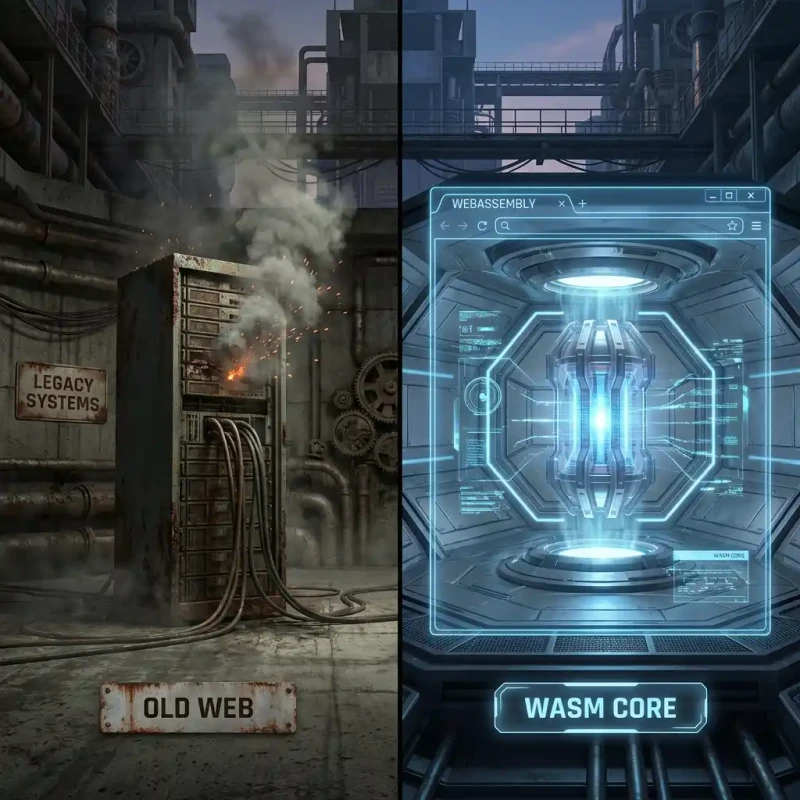

Discover how we ported industrial-grade C++ and Rust engines to the browser to achieve near-native performance for file processing.
For decades, the browser was just a thin viewer for text and images. If you wanted to do "real work"—compressing a 4K video, merging 500 PDF pages, or bulk-converting RAW photos—you had to download a desktop application. Modern web apps tried to solve this by moving the work to a server, but that created privacy and speed bottlenecks. At MojoDocs, we decided to break that mold using WebAssembly (WASM) and GPU acceleration.
How do we manage to run industrial-grade processing tools in a simple browser tab? In this engineering deep-dive, we'll look at the stack that makes local-first software the future of web development.
The Rise of WebAssembly (WASM)
JavaScript is an incredible language for building interfaces, but it wasn't designed for high-performance math. If you try to run a complex image compression algorithm in pure JavaScript, the browser will likely hang or run ten times slower than a native app. This is where WebAssembly comes in.
WASM is a binary instruction format that runs at near-native speed. At MojoDocs, we take high-performance engines written in Rust and C++ and compile them into WASM modules. When you load our site, your browser downloads these pre-compiled engines once. They are small (often under 5MB), and once they are in your browser's memory, they act like a desktop app running inside a high-security container.
Why Rust? The Choice of Memory Safety
When processing massive files (like a 500MB PDF binder), memory management is everything. Traditional languages like C can be prone to "memory leaks" or "buffer overflows" which lead to crashes—or worse, security vulnerabilities.
We chose **Rust** for our core processing modules because of its "Ownership" model. Rust guarantees memory safety without needing a garbage collector. This means MojoDocs is incredibly stable; it can handle thousands of images or massive documents without ever "bloating" and crashing your browser tab.
Concurrency: Multi-threading with Web Workers
One of the biggest hurdles in web processing is the "Main Thread." Normally, a browser is single-threaded. If the computer is busy crunching numbers for an image, it can't respond to your mouse clicks. The UI feels frozen.
MojoDocs solves this by using **Web Workers**. When you drop a batch of files:
- The Main Thread (UI) stays smooth and responsive.
- We spawn a pool of background Workers (child processes).
- Each worker takes a file, loads a WASM engine instance, and does the processing.
This allows us to utilize the full power of your modern multi-core CPU. If you have an M2 Pro or a high-end Ryzen processor, MojoDocs will actually be faster than a cloud tool because we aren't time-slicing a server with 1,000 other people—we have your entire computer's undivided attention.
Handling Massive Files: SharedArrayBuffer
Normally, passing data between the UI and a Web Worker requires "Cloning" that data. If you have a 100MB PDF, cloning it twice means you've suddenly used 300MB of RAM. This is inefficient.
We utilize SharedArrayBuffer (SAB). This allows the UI and the Worker to point to the exact same spot in your RAM. We call this "Zero-Copy" processing. It is the secret sauce that allows MojoDocs to handle files that would crash other "local-first" experimental tools. Note: Because SAB is a high-security feature, we have to serve MojoDocs with strict COOP and COEP headers (Cross-Origin isolation), ensuring your memory space remains impenetrable to other websites.
Comparison: The Technology Shift
| Architecture Component | Traditional Cloud Apps | MojoDocs Engine |
|---|---|---|
| Logic Execution | Server (Python/Node) | Browser (WASM/Rust) |
| Data Persistence | Database/S3 Bucket | Volatile RAM (Wiped on close) |
| Latency Source | Network RTT & Upload | Local CPU/Bus Speed |
| Concurrency | Limited by server worker pool | Limited by user device threads |
GPU Acceleration via WebGL/WebGPU
For image processing, we don't just stop at the CPU. For tasks like real-time previewing, sharpening, or filtering, we use the GPU. By writing shaders that run on your graphics card, we can process millions of pixels per second with near-zero latency. This allows our "Visual" tools to feel like professional desktop grade editors rather than slow online utilities.
The Benefit: Privacy as a Side-Effect of Engineering
The most interesting thing about this stack is that privacy isn't just a policy—it's a side-effect of the architecture. Because we engineered for speed (local processing), we accidentally achieved maximum privacy (no data transfer). You can't leak data that you never received. This is the ultimate "Win-Win" for developers and users alike.
Conclusion: The "Thick Client" Renaissance
We are seeing a return to the "Thick Client" era, but this time, the platform is the browser. MojoDocs is a pioneer in this space, proving that with Rust and WebAssembly, we can dismantle the data-hungry cloud-only models of the last decade. We are building for a world where your browser is more than just a window—it's a high-performance workstation.
Engineering Insight: Rust-to-WASM Bridge
// This bridge allows us to call binary Rust functions from JS
import init, { process_pdf } from './mojodocs_engine.js';

async function run() {
  await init(); // Loads the WASM binary
  const result = process_pdf(raw_file_buffer, { quality: 'high' });
  console.log('Processed locally at 90% native speed');
}