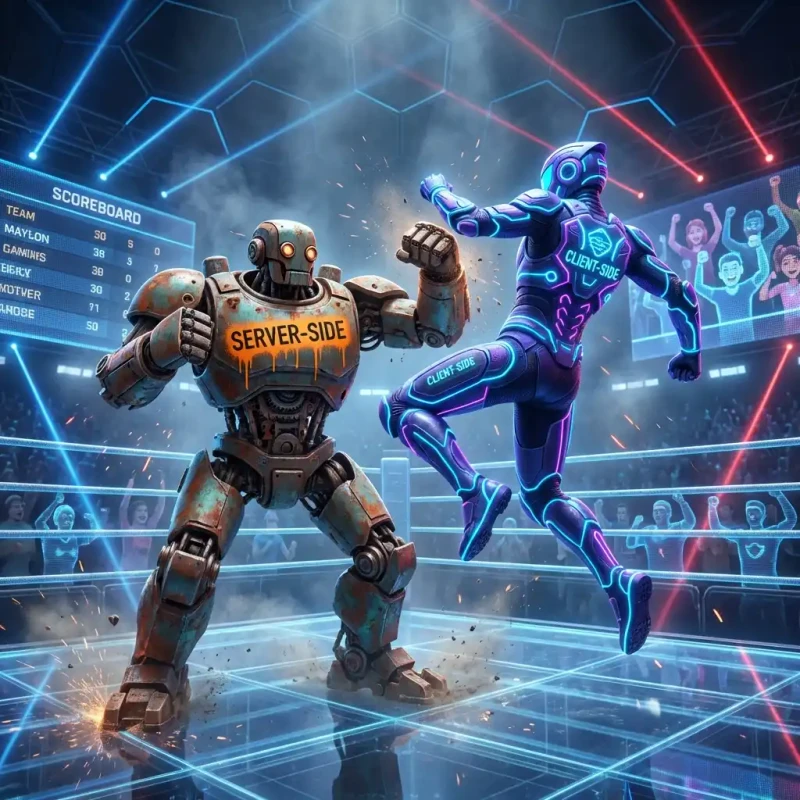
Two architectures enter, one leaves. We pit the traditional 'Server-Side' model against the modern 'Client-Side' revolution to see who really protects you.
The history of the web is a tug-of-war between two places: The Server (Cloud) and The Client (You). For 20 years, the Server won. It had the CPU power, the memory, and the code. But in 2026, the pendulum has swung. The devices in our pockets are supercomputers. The 'Client' is now the heavyweight champion.
At MojoDocs, we are team Client-Side. In this showdown, we’ll breakdown why moving logic from their server to your browser is the biggest upgrade you can make for your privacy.
Round 1: The 'Upload' Vulnerability
Server-Side: Requires an upload. This is a massive vulnerability. Data must traverse the public internet, pass through firewalls, load balancers, and finally land on a disk. Every step is a potential leak.
Client-Side: Zero upload. The code comes to the data, not the other way around. It removes the entire concept of 'transit' from the equation.
Winner: Client-Side (KO)
Round 2: Processing Power
Server-Side: Unlimited power... theoretically. But you are sharing that CPU with 10,000 other users. If the site is busy, you wait in a queue.
Client-Side: You have a dedicated CPU (M1/M2/Intel) just for you. No queues. No sharing. With WebAssembly, you utilize 100% of your machine's capability.
Winner: Client-Side (Speed)
Round 3: Trust
Server-Side: "Trust us, we delete your files." You have to believe a legal document.
Client-Side: "Don't trust us, check your network tab." You rely on the physical isolation of your hardware.
Winner: Client-Side (Verification)
Comparison: The Scorecard
| Category | Server-Side (Old Web) | Client-Side (MojoDocs) |
|---|---|---|
| Latency | High (Ping + Upload time) | Zero (Local Bus speed) |
| Scalability | Expensive (More servers) | Free (User hardware) |
| Privacy | Policy-based | Architecture-based |
| Dev Cost | Maintained Backend | Static Frontend |
Conclusion: The Revolution is Here
The Server-Side model had a good run. It built the internet. But for utility tools, its time is up. Client-Side computing is cleaner, faster, simpler, and infinitely more private. MojoDocs is leading the charge, but we expect the entire web to follow.
Engineering Insight: Smart Clients
The "Thick Client" concept is back. By shipping a 2MB WASM bundle to your browser, we turn it into a smart workstation. It's more efficient to move 2MB of code to the data than to move 200MB of data to the code.