The distributed supercomputer is already here, and it's sitting on your desk. Discover the sustainable architecture of 'Edge Computing' and why your MacBook is faster than an AWS instance.
There is a misconception that "Servers" are supercomputers. We imagine a glowing box at Google HQ that is infinitely powerful.
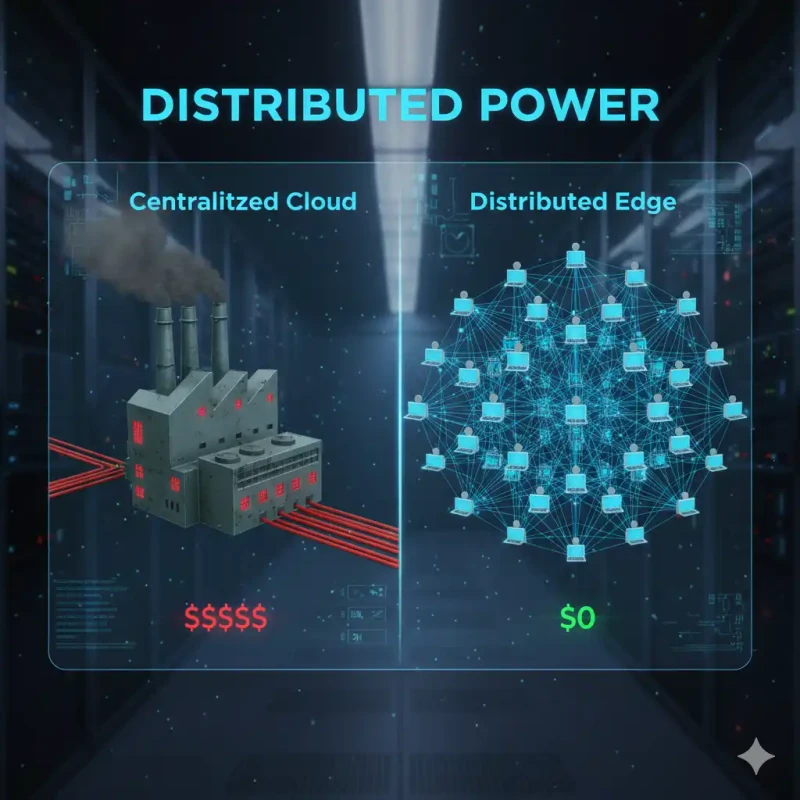
In reality, when you use a cloud API, your request is handled by a "vCPU" (Virtual CPU). This is often a tiny slice of a processor—maybe 1/8th of a core—that is being shared with 20 other users. It's often slow, throttled, and congested.
Meanwhile, the device you are reading this on—your laptop or phone—is likely a beast. It has 8 to 16 cores, a dedicated Neural Engine, and gigabytes of high-speed RAM doing... absolutely nothing. It's idling.
At **MojoDocs**, we asked a radical question: *Why are we paying Amazon to process images slowly, when our users have supercomputers in their pockets?*
The "Inverse Cloud" Paradigm
Traditional SaaS (Software as a Service) works like a rental car. You go to them. You use their infrastructure.
MojoDocs works like a 3D Printer. We send you the blueprints (The Code), and you build the product (The Result) in your own home.
Why Your RAM is Better Than Cloud RAM
- Latency: Accessing your own RAM takes nanoseconds. Accessing Cloud RAM takes milliseconds (plus network latency). That is a 1,000,000x difference.
- Bandwidth: Moving data from your CPU to your RAM is instant (50GB/s). Moving data to the cloud is slow (50MB/s).
- Availability: Your RAM is yours. It is never "Busy" serving another customer.
The Cost Equation (Why Free is Sustainable)
Users often ask us: *"How is MojoDocs free? What is the catch?"*
There is no catch. There is just math.
| Cost Driver | Competitor (Cloud) | MojoDocs (Edge) |
|---|---|---|
| CPU Time | $0.05 per minute | $0 (User provised) |
| Storage | $0.02 per GB | $0 (Ephemeral) |
| Scale Cost | Exponential | Flat |
Because our marginal cost is near zero, we don't need to annoy you with ads or subscriptions to pay huge server bills. Our architecture pays for itself.
The Privacy-Performance Link
This architecture is not just cheap; it's private by default. We call it "Privacy by Physics".
If we used servers, we would have to see your data to process it. By using your RAM, we physically cannot see it. We are blind. And in a world of data breaches, blindness is a feature.
Conclusion
The future of the web isn't bigger data centers. It's smarter browsers. We are unlocking the latent power of the billion devices already deployed around the world.
Welcome to the era of Browser-Based Power.