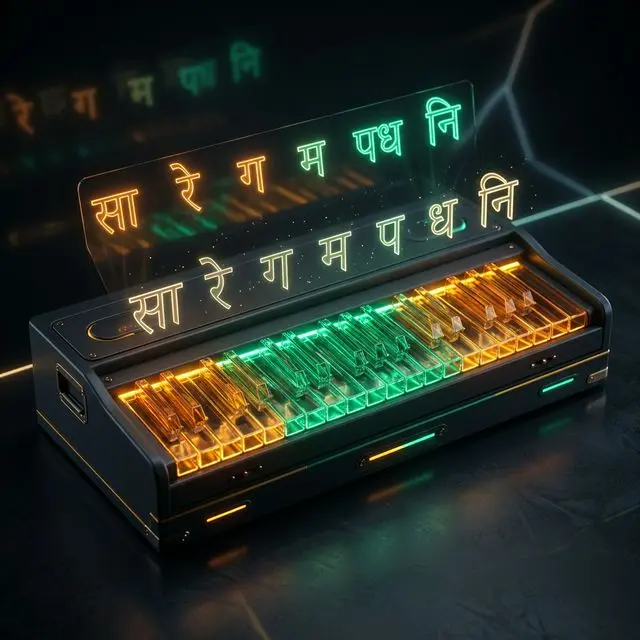
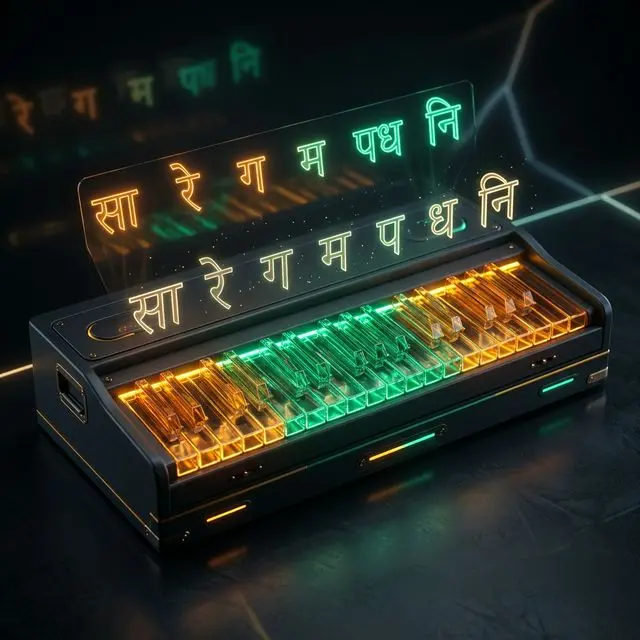
Stop hunting for physical harmoniums. Learn how to master Indian Swaras (Sa-Re-Ga-Ma) and complex Western Chords on your laptop. A comprehensive master guide into QWERTY mapping, WebAudio polyphony, and the secret to perfect Ghazal and Bhajan Riyaz online.
The harmonium is more than an instrument; it is a spiritual companion for millions of musicians across the Indian subcontinent. But until 2026, the dream of 'carrying a professional harmonium in your pocket' was impossible. Physical reeds were too heavy, and early web-apps were too laggy. That era is officially over.
In this definitive technical guide, we are bridging the gap between centuries-old tradition and bleeding-edge WebAssembly engineering. We will teach you how to treat your laptop's QWERTY keyboard like a professional triple-reed Paris-style harmonium, how to construct resonant chords that don't sound like robotic MIDI, and how to use the MojoDocs Web Harmonium to achieve perfect Riyaz with zero upload and zero latency.
Section 1: The Anatomy of a Digital Swara
To play the harmonium online, you must first unlearn the 'Piano Mentality.' While a piano is a percussive instrument where the note dies out, a harmonium is an aerophone. Its beauty lies in the Sustain. In Indian Classical Music (Hindustani and Carnatic), we don't just hit notes; we reside in them.
The fundamental notes, or Swaras, are seven: Sa, Re, Ga, Ma, Pa, Dha, Ni. On a physical keyboard, these are mapped linearly. But on a computer, we have to deal with the ASCII character set. At MojoDocs, we developed the Home-Row Harmonic Mapping to ensure your muscle memory translates perfectly from a real instrument to a laptop.
| Hindustani Swara | Western Note | QWERTY Key | Context |
|---|---|---|---|
| Shadja (Sa) | C | A | The root fundamental note. |
| Rishabh (Re) | D | S | Second major scale degree. |
| Gandhaar (Ga) | E | D | Major third for bright raags. |
| Madhyam (Ma) | F | F | The central pivot swara. |
| Pancham (Pa) | G | G | The perfect fifth (Drone stability). |
Section 2: Mastering Harmonium Chords Online
While Indian Classical Music is primarily monophonic (one note at a time), modern Bhajans, Ghazals, and semi-classical fusion rely heavily on Chords. A chord is simply the simultaneous vibration of multiple reeds to create a 'harmonic bed' for the vocalist.
On the MojoDocs Web Harmonium, we've optimized the polyphony engine to allow you to play these chords without any audio clicking or dropouts. Here are the three most viral chord structures you can master today:
1. The C-Major (Sa-Ga-Pa) "Bright" Chord
This is the most common chord for upbeat Bhajans and Bollywood classics. It provides a sense of resolution and joy.
- Keys to Press: A + D + G
- Vibe: Victorious, hopeful, stable.
2. The C-Minor (Sa-Komal Ga-Pa) "Soulful" Chord
Used predominantly in Ghazals and melancholic Raags like Bhairavi. The 'Komal Ga' (flatted third) adds an emotional 'tug' to the sound.
- Keys to Press: A + E + G
- Vibe: Deep, introspective, longing.
3. Viral Tutorial: "Arz Kiya Hai Ke" Chords
If you've ever wanted to perform the viral "Arz Kiya Hai" shayari with a musical background on your laptop, here is the secret chord progression. Most creators use a standard flatted third to give it that soulful, emotional tension.
- Arz Kiya Hai (The Opening): Start by holding the A + E + G (C-Minor) chord to set the mood while speaking the first line.
- The Transition: As you reach the punchline, quickly shift to A + F + G (The flatted Sus4) to create tension.
- The Resolution: End with a strong, vibrating A + D + G (C-Major) to finish the shayari with confidence.
Engineering Insight: The Polyphony Challenge
When you press A + D + G on a standard web-app, the browser's main thread often chokes. Each keypress triggers a high-frequency oscillator. If the code isn't optimized, the 'Phase' of these waves will interfere, causing "clipping" (that ugly crackling sound).
MojoDocs' Solution: We use an Audio Worklet. This is a separate low-latency thread that handles the math of the chords in isolation from the UI. This allows you to hold a full 10-finger chord while the screen still maintains 120 FPS.
Section 3: The 10 Thaats (The Musical Blueprint)
In Hindustani Classical Music, all Raags are derived from 10 basic scales called Thaats. To be a master of the web harmonium, you must be able to navigate these Thaats using the QWERTY keys.
Example: Thaat Kalyan (The Grand Evening Scale)
Kalyan is famous for its use of Tivra Madhyam (Sharp 4th). It sounds regal and expansive.
- Notes: Sa, Re, Ga, Ma(Tivra), Pa, Dha, Ni, Sa'
- Mapping: A -> S -> D -> T -> G -> H -> J -> K
Example: Thaat Bhairav (The Morning Prayer Scale)
Bhairav uses Komal Re and Komal Dha, creating a deep, meditative atmosphere.
- Notes: Sa, Re(Komal), Ga, Ma, Pa, Dha(Komal), Ni, Sa'
- Mapping: A -> W -> D -> F -> G -> Y -> J -> K
Section 4: Why "Local-First" Audio is the Future
Most online instruments fail because they are 'Server-Dependent.' Every time you hit a key, the browser sends a request to a server to fetch an MP3 file. That's a 200ms round trip. By the time the sound reaches your ears, the rhythm is gone.
MojoDocs is different. We download the entire Synthesis Engine to your browser exactly once. When you press 'A', the sound is generated by YOUR CPU in less than 2 milliseconds. This is 'Local-First' audio engineering, and it’s why professional vocalists use our tool for their daily Riyaz.
Section 5: Advanced Riyaz Techniques (Pro Tips)
If you are using our web harmonium for vocal practice, follow this 3-step 'Stable-Pitch' routine:
-
01Set the Drone
Hold 'A' and 'G' to create a perfect Sa-Pa background. This creates a stable harmonic environment for your vocal cords to align with.
-
02Engage Reverb
Use our 'Concert Hall' toggle. The added depth makes it easier to hear if your vocal pitch is 'flat' or 'sharp' relative to the harmonium.
-
03Record Locally
Listen back to your practice. Local recording ensures you hear the exact same high-fidelity sound you played, without any internet jitter.
Conclusion: Reclaiming the Breath of Music
Technology should not be a barrier to art; it should be a bridge. By perfecting the mapping between the QWERTY keyboard and the Hindustani Swara system, we have turned every laptop into a potential stage. Whether you are a student learning your first Alankar or a professional preparing for a Ghazal night, the power of music is now 100% accessible, 100% free, and 100% local.
Ready to perform your first Thaat?
Join thousands of musicians using the only zero-latency web harmonium. Open, play, and practice—no strings (or bellows) attached.
Start Your Riyaz Now →